
Humphreys Parole and Probation Types
Mississippi splits the decision to release from the work of supervision. The Mississippi State Parole Board decides whether parole should be granted, denied, or revoked. The Mississippi Department of Corrections Division of Community Corrections then supervises parole, probation, earned-release supervision, intensive supervision or house arrest, and interstate cases. A court imposes probation. It can do so without sending the person to prison, which means probation alone is not proof of a prison release.
Parole is conditional release from confinement under a Parole Board action. Earned-release supervision, often called ERS, also places an eligible person in the community, but Mississippi law keeps that person in inmate status and under MDOC jurisdiction. Probation is a court sentence served in the community, sometimes after a term in custody and sometimes instead of one. Final discharge is different from all three. It means the relevant term has ended, and it should be confirmed through the record held by MDOC or the court.
| Status | Who authorizes it | What it proves |
|---|---|---|
| Parole | Mississippi State Parole Board | Conditional community release, subject to processing and supervision |
| Probation | Sentencing court | A community sentence that may or may not follow confinement |
| Earned-release supervision | MDOC under state law | Community placement while MDOC jurisdiction and inmate status continue |
| Discharge | MDOC or the court, based on the sentence | Completion of the applicable term, best shown by an official record |
- Absconder
- A supervised person reported as failing to remain in required contact. This is not the same as escaping from jail.
- Revocation
- An official action that ends community supervision and can return a person to custody.
- Set-off
- The interval until the next parole hearing after a denial.
- Discharge
- The formal end of the sentence or supervision term, not just release from a building.
Check Humphreys Post-Release Supervision
No functioning public statewide probationer or parolee lookup was verified in the research. A state directory refers to a parolee search but routes users to MDOC without exposing a distinct tool. Verification therefore requires the right sequence. Start with identity and present location, then ask the office that holds the specific record. This avoids turning a parole eligibility date or a Board grant into a claim that physical release occurred.
- Search the MDOC offender system by MDOC number when known. Compare the name, descriptors, county of conviction, sentence, Location, and Location Change Date.
- If a facility remains listed as the current Location, do not report community release based only on a date or a vanished county entry.
- Contact the Humphreys Probation & Parole Office and ask whether public information confirms an active assignment and its type.
- For parole, ask the Parole Board for the public action and decision date. A grant is authority to release, not proof that processing ended.
- For completion, ask MDOC Records for the public discharge status or discharge certificate. Use the sentencing court for probation orders and court discharge.
An active parole or ERS assignment supports community release under MDOC control. It does not show full discharge or the exact exit time.
The broader Humphreys County released-inmate search explains how a sheriff movement record and the correct court docket establish what happened when a local booking ends. County release, state-prison parole, and probation are separate questions. Each needs its own custodian.
Humphreys Parole Office in Belzoni
The official Humphreys Probation & Parole Office is a local MDOC Community Corrections field office. It is separate from the Humphreys County Sheriff’s Office and from the Holmes/Humphreys County Correctional Facility in Lexington. The office page names Jason Carney as Community Corrections Director. It publishes no office hours, so call before traveling.
Humphreys Probation & Parole Office102 Castleman Street, Third Floor
Belzoni, MS 39038
P.O. Box 335
Phone and fax: 662-247-1873
Hours: not published
Ask a narrow status question. Useful wording is whether the office can confirm an active public Community Corrections assignment and whether the supervision type is parole, ERS, probation, or another category. Staff may limit what they disclose. The office is still the most direct local route for supervision, while MDOC Records is the stronger source for sentence calculation and final discharge.
The official Community Corrections page shows the kinds of supervision MDOC administers.
View MDOC’s types of supervision before comparing the status terms.
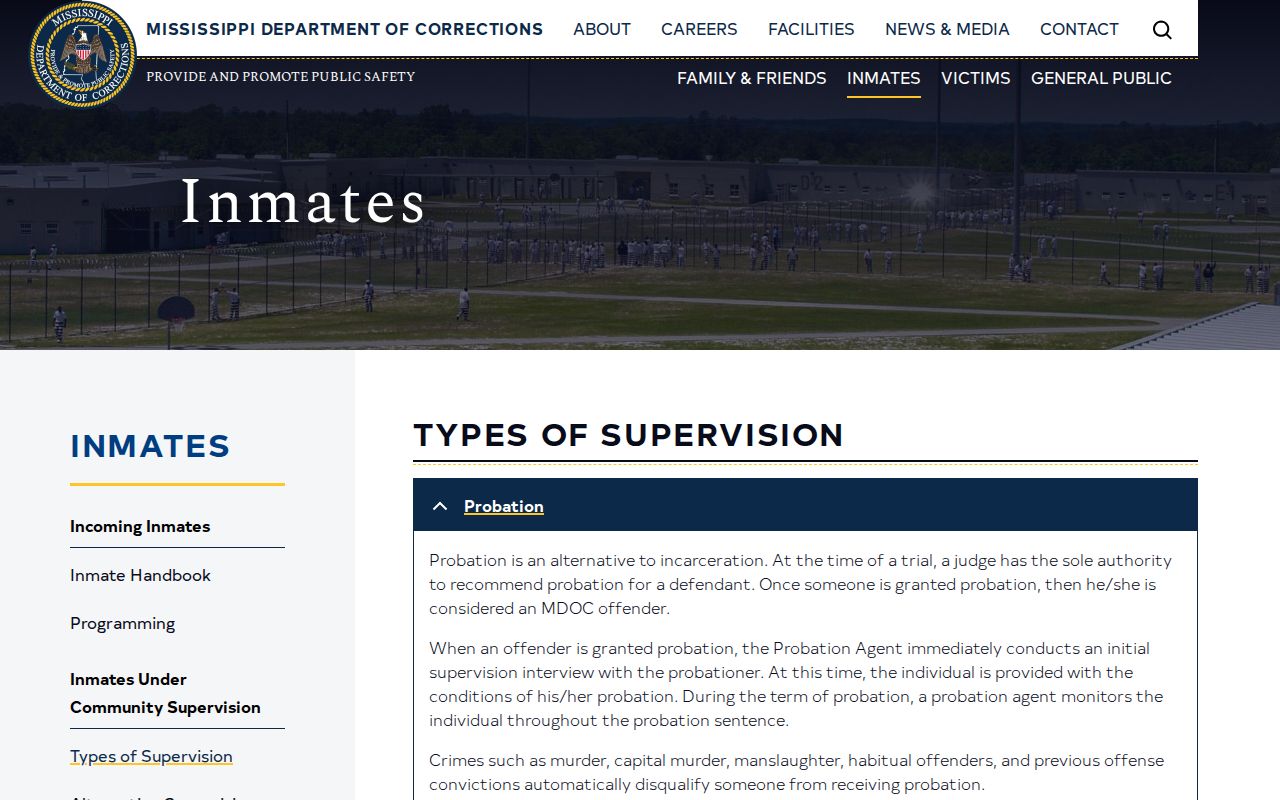
The official screen helps distinguish parole, probation, and other Community Corrections categories, but the local office must confirm a named person’s public status.
Note: The Belzoni field office verifies supervision; it does not replace the Parole Board’s decision record or MDOC’s discharge record.
Humphreys Parole Release Reporting
Mississippi State Parole Board administrative rules generally require a parolee to report to the assigned field office within 24 hours of actual release unless directed otherwise. This makes the Belzoni office a useful route after a recent state-prison release. The rule is an administrative duty, not a public schedule. It should not be used to predict where a specific person will be or to infer that a grant has already become a completed release.
For Board action, contact the Mississippi State Parole Board at 239 North Lamar Street, Suite 501, Jackson, MS 39202, phone 601-576-3520, or MSStateParoleBoard@mdoc.state.ms.us. Ask for the public action, decision date, and next eligible or set-off date. For sentence completion, contact MDOC Records at 601-933-2889 or MDOCRecordsDepartment@mdoc.state.ms.us. These offices answer different parts of the same timeline.
The official field-office listing can be checked at its source.
Open the MDOC Humphreys office listing for current agency details.
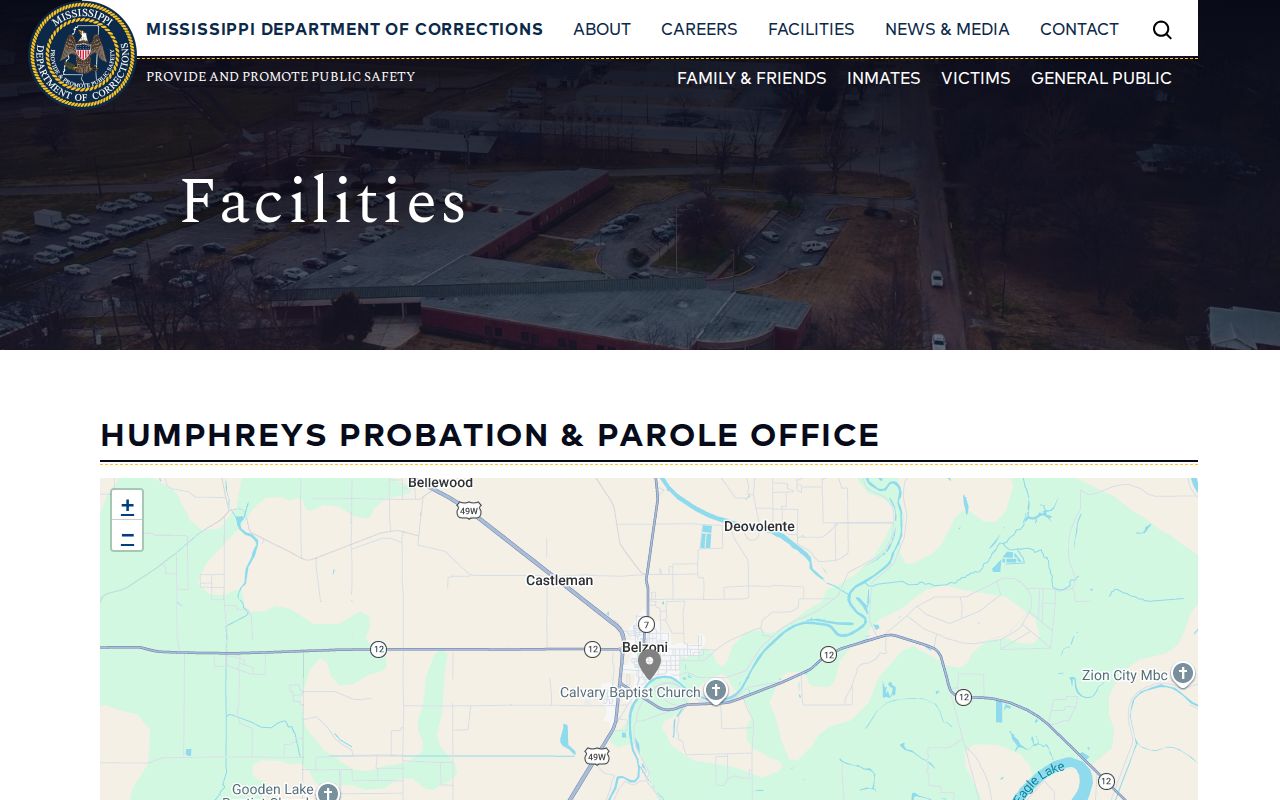
The listing confirms the local Community Corrections channel and keeps it distinct from county jail records and the regional correctional facility.
Humphreys Parole Board Records
Parole hearings are not a public county calendar. Mississippi’s rules provide that hearings are closed and may proceed by file review, in person, by phone, or by teleconference. Board staff sets the appointment. No official public hearing calendar or searchable results database was verified, so a missing web result cannot be treated as a denial, grant, or discharge.
A hearing generally must occur no later than 30 days before the eligibility month, with consideration possible in that month or either of the two prior months. The Board sends its written decision to the inmate within ten days after deliberation. A denial action sheet states the reasons and set-off. The Board also keeps a minute book of official actions and reasons, though disclosure can be limited for safety or confidentiality.
Eligibility is not release. Sections 47-7-3 and 47-7-18 govern key parole routes, with offense-date rules and exclusions. A personalized date should come from the official computation, not a simple percentage calculation.
Humphreys Supervision Violations and Absconding
Conditions vary by order and supervision type. At a high level, a person must follow the court, Board, or MDOC terms and remain in contact as directed. A reported violation can lead to investigation, a warrant, a hearing, added conditions, or revocation. Do not treat a rumor, missed appointment, or old online entry as an official warrant or absconder record.
No official Humphreys County absconder list was found. MS SAVIN/VINE may transmit an absconding event from supervision, along with events such as release, transfer, return, and escape. Read the event label precisely. Then confirm it with MDOC or the reporting agency. An absconder is a person alleged to have lost required contact while in the community. Escape describes leaving custody without authority, which is a different event.
Note: A VINE supervision alert is timely evidence of an agency update, but the reporting office remains the source for confirmation.
Humphreys Release IDs and Corrections
MDOC’s reentry-documentation program describes preparation for a state identification card or driver’s-license documents before a state-prison release. It also addresses resources needed just after return. This is an MDOC pathway. It should not be promised to someone leaving a short Humphreys County jail stay, since local custody and state custody use different release systems.
Record corrections follow the same custodian rule. MDOC corrects its offender and supervision data. The originating sheriff handles errors in a Humphreys booking or release record. The court clerk handles docket and order issues. For a qualifying registration record, the Mississippi Sex Offender Registry has a separate correction channel at 601-987-1540 or MSOR@dps.ms.gov. Registry status is not a general test for parole, probation, or recent release.
Identification help and record correction both matter after release, but neither proves custody ended. Use the discharge, movement, court, or active-supervision record for that conclusion.
Humphreys Supervision Discharge Records
Community placement and discharge are not synonyms. A person on parole or ERS has left institutional confinement but remains under state authority. Probation likewise continues until the court or supervising authority ends it. The cleanest proof of completion is an official discharge record, not a tentative date, Board grant, or lack of a current online entry.
For an MDOC term, request public discharge status or a discharge certificate from MDOC Records, P.O. Box 24388, Jackson, MS 39225. Include the MDOC number and define the record sought. For probation, request the sentencing order and any later discharge or revocation order from the court that imposed it. If sources conflict, preserve each date. The Board decision date, physical release date, start of Community Corrections, and final discharge can all be different.