
Humphreys Projected and Actual Dates
Mississippi’s public MDOC record uses the label Tentative Release Date. MDOC also calculates earned-release supervision, tentative release, and maximum release dates. Each serves a different purpose. The public tentative field predicts a possible date under the data and rules then applied. It does not record the exact time a person walked out, and it does not establish that the sentence ended.
A pretrial detainee usually has no sentence-based projected date. Bond may be posted, a judge may modify conditions, charges may be dismissed, or another agency may take custody. The Humphreys County Sheriff’s final movement entry can show when local custody ended and the destination. The controlling court order explains the legal authority. For a sentenced MDOC prisoner, the offender detail, official time computation, case manager, and discharge certificate answer different stages of the release process.
Scheduled versus actual: a tentative date forecasts an event. A sheriff exit record or MDOC discharge documentation confirms what occurred.
MDOC warns that state law can cause release types and dates to differ from its website. A date in the past should prompt a current Location check, not an automatic conclusion that the person is free. A correctional location can still mean institutional custody. An active Community Corrections assignment can mean release to parole or ERS while state jurisdiction continues.
Find a Humphreys Release Date
The correct route depends on the last known custodian. Humphreys County Jail handles local booking and movement records. MDOC handles state-prison sentence computation. The Holmes/Humphreys County Correctional Facility in Lexington holds state inmates in a regional setting under MDOC oversight, so a departure from that building can be a transfer within MDOC rather than a return to the community.
- Identify whether the person is a pretrial county detainee, county-sentenced inmate, sentenced MDOC prisoner, or federal detainee. Do not mix those systems.
- For MDOC custody, open the MDOC offender search. Use the MDOC ID when known, or exact first and last name.
- Compare identity, County of Conviction, Entry Date, Location, Location Change Date, sentence count, sentence length, and Tentative Release Date.
- For a local booking, call the Humphreys County Sheriff’s Office at 662-247-2551 and ask for the existing booking, release, and movement record.
- For a sentence computation, contact MDOC Records with the MDOC number and request the time sheet, jail-credit calculation, public status, or discharge record.
- Use the court docket for the sentence, credit ordered by the court, bond action, dismissal, revocation, or amended order. Pair it with the custodian’s physical-movement record.
The Humphreys County release-record path covers the local sheriff request and court routing in full. A current jail roster, if one existed, would answer who is held now. It would not provide a durable archive of people already released. No official Humphreys County online roster or projected-date tool was verified.
Note: A county booking that disappears after a felony sentence may signal transfer to MDOC, not release to the community.
Humphreys MDOC Release-Date Fields
The official detail layout contains a portrait, name, MDOC ID, physical descriptors, Entry Date, Location, Unit, Location Change Date, Number of Sentences, Total Length, offense, Sentence Length, County of Conviction, Sentence Date, and Tentative Release Date. These fields help confirm identity, the sentence context, and whether MDOC still lists an institution. They do not always establish a final discharge.
| Field | How to read it |
|---|---|
| MDOC ID | The strongest public search key when names are similar |
| Location | The current MDOC place or status shown by the system |
| Location Change Date | A movement date, not necessarily a community-release date |
| County of Conviction | A way to compare the record with the Humphreys court case |
| Tentative Release Date | A predictive date that still needs official confirmation |
| Sentence fields | The term, offense, and structure that feed the computation |
The official MDOC detail screen demonstrates the exact public label.
View the MDOC offender-detail structure used to interpret a tentative date.
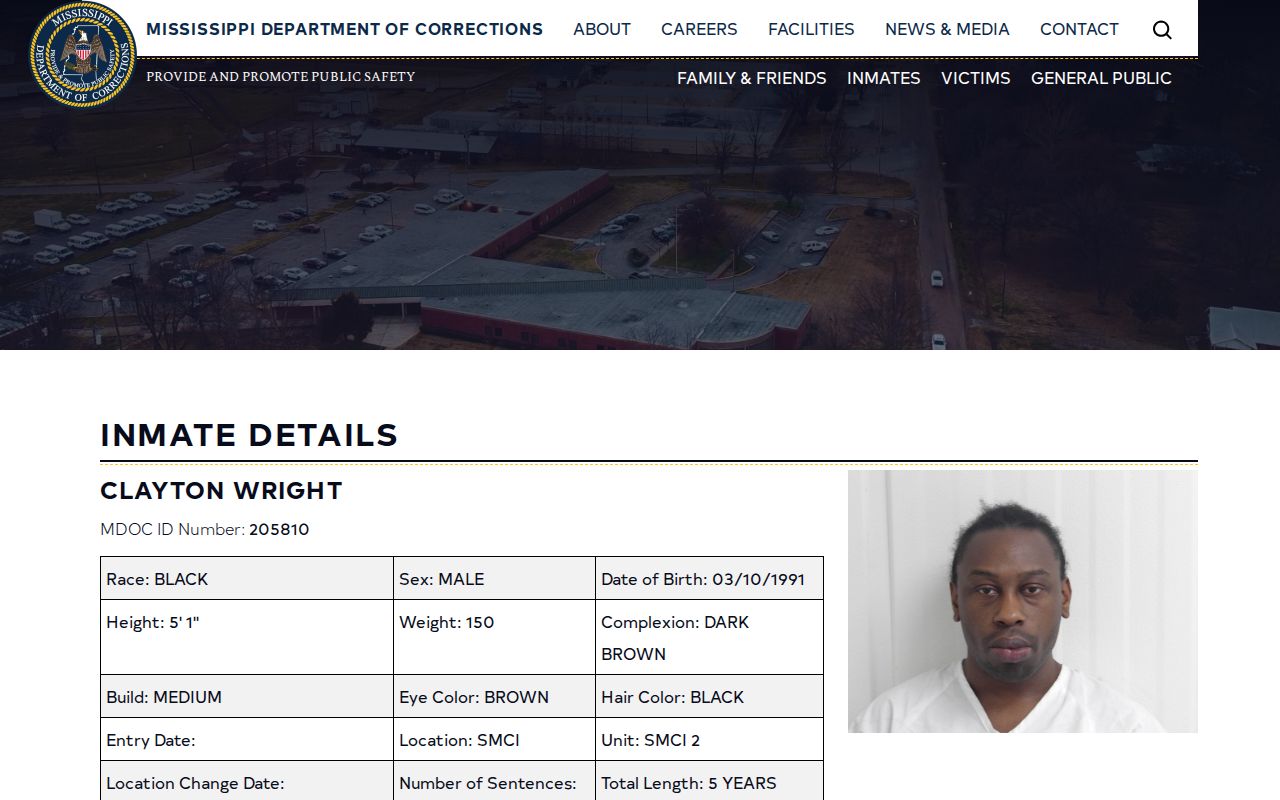
The screen places the tentative date beside identity, location, and sentence data, which is why all fields must be read together.
Humphreys Earned-Time Release Rules
For many Mississippi sentences imposed after June 30, 1995, Miss. Code §47-5-138 allows 4.5 days of earned time for each 30 days served, capped at 15 percent. That produces the familiar 85-percent shorthand. It is not a promise that each prisoner leaves after serving 85 percent. It is one part of a sentence computation.
Section 47-5-139 excludes categories that include life sentences, habitual sentences under specified statutes, sex crimes, and some mandatory armed-robbery time. Earned time can also be forfeited. Current law has limited exceptions, and the offense date matters. MDOC, not a web calculator, should determine an individual computation.
Pre-sentence county-jail credit can change the sentence-begin date. The MDOC inmate handbook says eligible time must tie to the cause number and fall between the offense date and earliest sentence date. Concurrent terms run together, while consecutive terms run one after another. Mandatory time, credit errors, and sentence amendments can all alter the working date.
- Earned time
- Credit allowed under state law that can reduce eligible time, subject to caps and forfeiture.
- Jail credit
- Qualifying pre-sentence custody tied to the case and applied to the sentence computation.
- Concurrent
- Two or more terms served at the same time.
- Consecutive
- Terms served one after another.
- Maximum release date
- The sentence-end calculation apart from earlier conditional release routes.
Note: Earned time cannot reduce the separate statutory floor for parole eligibility.
Why Humphreys Release Dates Change
A public date may move because the information beneath it changed. Some factors affect the sentence itself. Others affect whether the person can leave a particular facility on that date. A detainer, for example, is a request or authority from another agency to hold or receive the person. It can mean one custody ends while another begins.
| Factor | Possible effect | Best source |
|---|---|---|
| Earned-time gain or forfeiture | Moves an eligible tentative date | MDOC time computation |
| Jail-credit correction | Changes the sentence-begin calculation | MDOC Records and sentencing order |
| Consecutive sentence | Adds a term after another term | Judgment and MDOC sentence fields |
| Detainer or hold | Can cause transfer to another authority | Movement record and receiving agency |
| Parole action | May authorize conditional release after processing | Parole Board action and Community Corrections |
| ERS residence approval | Can affect readiness for community placement | MDOC case manager |
| Court order | May amend, revoke, credit, or otherwise alter the term | Court docket and filed order |
Release processing can take 30 to 45 days, according to the MDOC frequently asked questions. That source also directs exact-date questions to the case manager and says the inmate must receive a discharge certificate. Processing, transport, another hold, or an unapproved ERS residence can therefore separate a computed date from a physical departure.
Humphreys Parole Eligibility Dates
Parole eligibility is a separate calculation. Under §47-7-3 and Board rules, general thresholds differ for nonviolent offenses, offenses classed as violent, specified offenses with higher percentages, and some drug offenses. Habitual, sex, capital, murder, trafficking, and other barred categories have exclusions. Offense date and current law control.
For post-June 30, 1995 terms, the researched rules describe general nonviolent eligibility at 25 percent or ten years, whichever is less. An offense classified as violent under §97-3-2 generally requires 50 percent or twenty years. Armed robbery, drive-by shooting, and carjacking generally use 60 percent or twenty-five years, while qualifying nonviolent, nonhabitual drug offenses generally use 25 percent or ten years. These are statutory categories, not a personal prediction. Mandatory minimums, offense-specific bars, prior-sentence status, and later amendments can control instead.
Section 47-7-18 also allows a no-hearing release route for certain otherwise eligible people only when all statutory conditions are met. Those conditions include case-plan work, conduct, acceptance of terms, and an approved discharge plan. Eligibility is not a grant. A grant still is not the exact exit time. The Board action, MDOC Location, Community Corrections assignment, and discharge or movement record must be reconciled.
No public Humphreys parole calendar or searchable decision list was verified. For a public Board action, contact the Mississippi State Parole Board at 601-576-3520. For active supervision, contact the Humphreys field office at 662-247-1873.
The Board’s process is tied to the individual eligibility month rather than a public Humphreys County hearing calendar. Official rules allow file review, in-person review, telephone, or teleconference, and hearings are closed. A written denial includes reasons and a set-off before the next review. A grant authorizes the release path, but MDOC must still complete its work and account for any hold or approved plan.
How Humphreys Dates Are Computed
A sound audit gathers the sentence date and length, offense statute and classification, County of Conviction, concurrent or consecutive structure, eligible jail credit, earned-time status, forfeiture, parole rule, ERS plan approval, detainers, and current Location. The 15-percent cap can explain one part of the date, but it cannot resolve exclusions or the parole floor. Residence approval can affect ERS. Another agency’s detainer can change the destination.
Request the official computation from MDOC Records at P.O. Box 24388, Jackson, MS 39225, phone 601-933-2889, or MDOCRecordsDepartment@mdoc.state.ms.us. Identify the MDOC number and ask for the smallest existing record that answers the question. Good examples are a time sheet, jail-credit calculation, eligibility record, or discharge status. Avoid asking staff to make a legal prediction.
This Mississippi-specific chain is the distinctive point: Tentative Release Date, ERS date, maximum date, and parole eligibility can coexist without matching. The discharge certificate confirms completion. Until then, each date must retain its own label.
Confirm a Humphreys Release Date
Start with the current custodian. For Humphreys County Jail, request the exact release or movement timestamp and destination. For Holmes/Humphreys County Correctional Facility or another state location, use MDOC Records, the case manager, and the discharge record. For parole or ERS, confirm the Board action or active Community Corrections assignment without calling it final discharge.
A VINELink Release Check can provide an event alert for a participating county or MDOC record. Read whether the event says release, transfer, return, temporary movement, or absconding. VINE does not cover BOP custody, and an alert should be confirmed with the agency that supplied it.
Keep all dates when records conflict. A court order may precede processing. A Location Change Date may mark a transfer. A VINE timestamp may reflect the system update. The physical exit record and discharge certificate answer narrower, stronger questions than a projected field.